Showing posts with label Cooking. Show all posts

Sunday, May 2, 2021

Cookies Eat Dinosaur

The Caramel That Tried To Escape

By Orange Planer, Virtual Ability member

It was a quiet Sunday afternoon when my wife said, “I need chocolate!”  I like to think I’m a good husband, so I raise my bulk off the couch to make my top-secret chocolate cookies.  Re-reading the recipe is always a good thing, so after doing that I promptly forget everything, mix all the dry ingredients, crack the two eggs into a bowl, and wait for the butter to soften.

After an hour or so the butter is softened.  The recipe doesn’t make a lot of cookies, so out comes the smaller bowl and the beater with the rubber scrapers on the edge.  Time to cream the butter (beat a lot of air into it).  The butter goes into the bowl, I start the mixer on low and slowly speed it up.  Great, the butter has gone from soft yellow to white with the additional air.  The recipe says to add two cups of sugar (to beat a lot more air into it).

We have trouble:  the sugar was combined with all the other dry ingredients.  Now what?  Well, there's sugar in there SOMEwhere, hopefully it will help cream the butter…  I add the first of two cups of dry ingredients and put the mixer on low.  Uh oh.  I forgot cocoa powder is light and prone to fly all over the place.  Result:  happy, graceful cocoa powder clouds rise into the air.

In for a dime, in for a dollar.  I continue adding dry ingredients with the mixer on low.  So far, so good, the cocoa powder clouds are subsiding, but the butter is sticking to the beater shaft.  Increasing the mixer speed from 2 to 4 should take care of that.

We have more trouble:  I did not wait until the dry ingredients were incorporated.  Now unhappy, not-so-graceful, cocoa powder clouds color the air around me.  It’s in my mouth, it's coating the mixer, the rest of the kitchen, and it's all over me.

Well, that did not work, so after turning off the mixer and scraping the butter off the beater shaft, the dry ingredients get incorporated.  Now it is time to finish creaming the butter with the mixer at high speed.  That is also when I realize the bowl is not big enough. Dough is starting to spew all over me and the kitchen.

I turn off the mixer, clean up the mess, and get out the BIG bowl, 5.5 quarts.

And, on a hunch to keep the clouds under control, I change from the beater with the scrapers to the one without scrapers.  I also bring out the two-piece bowl cover that has a ramp where I can slide in dry ingredients.  Of course, the way this day is going, it does not fit.  It was made for a smaller bowl.

All right, I remove the half of the bowl cover without the ramp, hold the part with the ramp in place using one hand, and turn the mixer on low.  With my free hand I try to put the cap on the vanilla extract.  I knock the bottle over, spilling a teaspoon or so on the counter and all over the instructions.  After picking up the bottle with my free hand, I’m starting wonder whether I should just go to the store, but my pride is at stake.  These cookies won’t defeat me!

I am still holding the half bowl cover with one hand, so I grab a cloth and wipe up the vanilla with the other hand.  I think about putting the cloth in the sink, say “heck with it,” and throw the cloth onto the instructions, 'cause.

Time to start adding the eggs.  This is a little tricky because the recipe says to add one egg at a time.  The first egg goes in just fine, along with about half the egg white using the ramp on the cover.  I wait for the egg to mix in, pour the other egg down the ramp and into the bowl… and somehow the egg yolk misses the ramp, breaking on the counter.  I sigh in frustration.  Well, there's nothing on the counter but cocoa powder, so I scrape it up and put it in the bowl and let it finish mixing.  Now it's time to put in the dry ingredients.

Well, the rest of the dry ingredients.

Trying to keep the unhappy clouds from happening again, I leave the mixer on low and pour a cup of the mixture down the ramp.  Had I forgotten that there was egg white on that ramp?  Yes.  A whole bunch of the dry ingredients sticks on the ramp, but most of it gets in the bowl.  But because the mixer is moving, unfortunately, my attempt at reducing the unhappy clouds is an abject failure.

Now there are angry cocoa powder clouds that make me think of Mt. Kilauea and I can barely see anything.  No wonder they evacuate people from around active volcanoes.


Picture of an erupting volcano with clouds of brown gas

Finally, the remaining cocoa powder and the rest of the dry ingredients get incorporated, but as before it is sticking to the shaft of the beater.  I speed up the mixer to 8 to spin it off with no luck.

Time to bring out the muscle.  Out comes the silicone spatula.  I am partway through mixing the dough when I realize that (a) my trigger finger is bad – the right ring finger is locked on the spatula – I cannot change grip; and (b) remember when I said I stopped using the beater with the scrapers?  Yeah, that would have been useful right now.  About a half cup of the dry mixture is at the bottom of the bowl, unmixed.

I pull the spatula from my hand and unwind my finger with the other hand.  Now I can change grip from “fist” style to how I hold a pen.  I slowly (because I forgot silicone spatulas are freakishly soft!) mix the rest of the dry ingredients in.  I ask my wife if she wants to taste the batter.  After observing the kitchen, the bowl, the implements of destruction, and me she just licks my arm.

"Tastes good!" she says, and heads back to the living room.

I sigh.

The dough is now cooling in the fridge.  Everything's been wiped down, washed, put in the dishwasher, or otherwise sanitized.

But it will not surprise me if my coffee tomorrow turns out to be mocha.

Top Secret Chocolate Cookies


Yield: 2 1/2 dozen cookies
Level: Easy
  • 2 1/2 sticks unsalted butter, room temperature
  • 2 cups sugar
  • 2 large eggs, unbeaten
  • 1 tablespoon vanilla extract
  • 3/4 cup Dutch process cocoa powder
  • 2 cups all-purpose flour
  • 1 teaspoon baking soda
  • 1/2 teaspoon salt
  • White Sanding sugar, for garnish (optional)

  1. In a large bowl, cream the butter and sugar together with a hand mixer.

  2. Add the eggs and vanilla extract to the creamed mixture and mix until combined.

  3. In a medium bowl, mix the cocoa powder, flour, baking soda, and salt.

  4. Slowly add the dry ingredients to the butter mixture and continue mixing until incorporated.

  5. Roll the dough into TWO logs that are about 2-inches high and 1-foot long. Wrap the dough logs in waxed paper and place in the refrigerator for 2 hours.

  6. Preheat oven to 350°F.

  7. Once the dough is thoroughly chilled, slice the logs into 1/2-inch thick rounds and dip all sides in sanding sugar. Place dough rounds on a parchment paper-lined cookie sheet and bake for 10 minutes.

  8. Cool cookies on a wire rack.

Saturday, January 30, 2021

Tips - Tricks to Cook Leaner

Picture of overweight man behind a burger and fries
Sometimes a cheeseburger and fries is not good for you

Meats are one source of excess fat in our diets. Consider substituting lower fat ingredients, such as ground chicken (6 grams fat/4 ounce serving) or turkey for higher fat ground beef (11-17 gm fat/4 oz) in recipes from meatloaves to tacos. You might also see if your taste buds will accept turkey bacon (28 grams fat per 100 grams cooked) or lean prosciutto (5 gm fat/100 gm serving) instead of pork bacon (42 gm fat/100 gm cooked).

Full-fat dairy products are another source of dietary fats. If you typically use sour cream (48.2 gm fat/cup), try fat-free plain yogurt (0.4 gm fat/ cup) instead.

Cooking oils are another common source of fat in our foods. Did you know that you can substitute applesauce (.2 grams fat/ cup) for half of the butter (184 gm fat/ cup) or canola oil (218 gm fat/ cup) in recipes for quick breads and cakes?

These simple switches can aid your campaign against excess dietary cholesterol and other fats. To check out fat content of foods and ingredients, and even find out how much exercise you would need to do to burn off the calories, check out the CalorieKing website.


Friday, January 1, 2021

Grocery Shopping Tips for Healthier Cooking

Overhead view of supermarket fruit area
Supermarket stalls

To prepare healthy meals at home, you need the right ingredients. Here’s how to shop so that you have the best recipe materials in your pantry.

  1. Take an inventory of what you already have.
    Make a list of not only the staples (low-fat milk, whole grains in breads and pasta, fresh fruits and vegetables) that you regularly run out of, but also of items on kitchen and pantry shelves. What canned goods do you already have that you could incorporate into upcoming meals?

  2. Plan meals until your next shopping trip.
    Using the inventory, find nutritious recipes that incorporate the items on the list. Make a plan for daily meals and snacks that include these products in healthy recipes. 

  3. Make a shopping list.
    Using the menu plan you have developed, make a list of items to purchase. Try to organize your list so that items are arranged in the order you will encounter them as you move through the store. Shopping from a list makes the trip more efficient, and curbs impulse buying of unhealthy items.

    You can always be on the lookout for healthy items that are not on your list. Give yourself the opportunity to try out a new fruit or vegetable. Often these make convenient healthy snacks.

  4. Don't shop when you're hungry.
    You are more likely to grab high-fat, high-calorie snack items when you're hungry. Shop for groceries only after you've eaten a good healthy meal. If you must shop on an empty stomach, drink some water or buy a single piece of fruit. Pay for it, enjoy eating it, then shop.

  5. Shop the perimeter of the grocery store for fresh foods first.
    Fresh produce, dairy, poultry and seafood are generally found around the outer edges of most grocery stores. These fresh foods are generally better for your health than ready-to-eat foods; when you cook with fresh ingredients, you know exactly what is in the dishes you serve.

  6. Read nutrition labels.
    Check nutrition labels on packaged goods. Look at the serving size, calories, fat, cholesterol and sodium. Even low-fat or fat-free foods may have a lot of calories. Don't be fooled; not all packages are single-serving.

    Compare the nutrition labels of similar products so that you can choose the healthiest option. Even when ordering groceries online, you can often examine the labels.


Tuesday, October 6, 2020

TIP - How to Tell if Eggs are Fresh

Fresh chicken egg cracked out of its shell

Your grandmother may have had to check the freshness of farm eggs by dunking them, still in their shells, into water. The belief was that fresh eggs would sink and eggs you would not want to cook or eat would float.

This old wives’ tale is not entirely accurate, however. It is true that the air cell inside the eggshell enlarges as the egg ages. But floating eggs may still be safe to eat. Crack the egg into a bowl and check its appearance and smell before deciding whether to use or discard it. A spoiled egg has a distinctive sulfur-like odor known as “rotten egg smell.” If the egg smells OK, it is likely safe to cook with.

There is a better way to check the freshness of eggs you get from the grocery. Check the egg carton!

Eggs packed at plants that are under US Department of Agriculture (USDA) inspection have a pack-date number on the carton. These 3-digit numbers (called Julian dates) range from 001 to 365, and indicate the date (from January 1 through December 31) that the eggs were packaged. The American Egg Board states that raw eggs stored in their cartons in the refrigerator are safe to eat for four to five weeks beyond the Julian date.

Egg packing at plants not under USDA inspection comes under state laws for labeling. Most require a Sell-By or EXP date, which is a direction to the store, but is also the consumer’s guarantee of freshness for a couple of weeks past that date.

For a downloadable infographic explaining Julian and Sell-By dates and many other labels found on egg cartons, please see: https://www.incredibleegg.org/egg-types-packaging.

Monday, October 5, 2020

Things to Do - Oct 6-10 Eggstravaganza Virtual Family Week

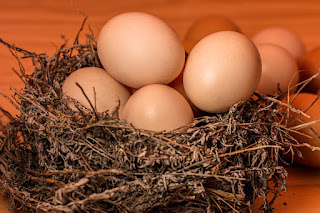
Bird nest full of brown eggs
A very full nest of eggs

It used to be that we felt we could not eat many eggs because the yolks contain cholesterol. Now we know that saturated fat, not dietary cholesterol, has a great effect on blood cholesterol and thus the risk of stroke and heart attack.

In fact, research published in The American Journal of Clinical Nutrition in April 2020 reviewed the effect of eggs in the diet on 177,000 people in 50 different countries. The researchers found no association between those who ate an average of more than an egg a day compared to those who ate less than one egg per week on measures such as blood lipids, mortality, and major cardiovascular disease events. Moderate egg consumption is safe!

Manitoba (Canada) Egg Farmers is sponsoring a five-day Eggstravaganza! Starting Tuesday, October 6, each day offers a fun family activity. On the 6th, learn to cook classic deviled eggs with dietitian Carla D’Andreamatteo and her daughter. Carla has worked with Virtual Ability in the past on a nutrition education research project. She also did a presentation on Healthinfo Island during the Women in Science celebration.

There is a Twitter Party for adults on the 7th and TWO fun events for kids on the 8th. Learn magic tricks you can do at home on YouTube at 8am SLT with magician Cary Tardi. At 5pm SLT attend a party with Elsa, Spiderman, and your children on Zoom.

Friday, Oct 9, which is World Egg Day, Canadian egg farmers answer your questions about hens, eggs, and egg farming. This special week ends on Saturday with a virtual tour of a working egg farm

If that’s not enough family activities about eggs, your kids can sign up for a free fun egg-tivity kit that contains an activity for each day of the Eggstravaganza week.

Sunday, June 21, 2020

How to Prepare Food Safely During a Pandemic

Men in fire suits in front of barbeque


At present, it does not appear that COVID-19 is spread through food. However, this is a good time to practice good food preparation hygiene. Here are some tips.
  • Wash your hands properly before and after touching raw food, before and after cooking food, before serving or eating food, and after eating.
  • Wash countertops, cutting boards and kitchen utensils with hot soapy water before use, and between various food items. This is especially important to isolate animal products such as meat, fish or poultry.
  • Wash fresh fruits and vegetables thoroughly before cooking them or eating them raw. For complete information on how to wash various types of fruits and vegetables, consult this source: https://extension.wsu.edu/foodsafety/content/washing-fresh-produce/
  • Clean off the tops of cans before you open them. It’s also important to clean the can opener blade after use. For more on why you should clean the tops of cans before opening them, read this: https://dfw.cbslocal.com/2013/02/04/yuck-whats-on-that-soda-can-cbs-11s-i-team-finds-out/
These hygiene practices are ones you should have been following all along. If you haven’t, perhaps now is the time to start making them part of your food preparation habits.

For more information on COVID-19 and food safety, please download this PDF: https://foodsafety.ces.ncsu.edu/wp-content/uploads/2020/03/Food-Safety_COVID-19_Flyer_031720-1.pdf

Saturday, February 29, 2020

Myths You May Believe About Food For Heart Health

Mythical desert horse with reindeer horns
Food myths as told by the Mythical Desert Horse

Myth: Avoid eggs, especially the yolks

We have been told, incorrectly, that because egg yolks contain cholesterol, they are bad for our heart health. This is a myth.  Most of the cholesterol in the human body is made by the liver. Not much comes from food.

Other dietary sources of fats, especially saturated and trans fats, are more dangerous to your health than dietary cholesterol.  An article in the journal Nutrients points out that eggs are affordable, nutrient-dense foods. They provide protein and vitamins A and D along with other vitamins and minerals. Moderate consumption of eggs (minus bacon or cheese!) can be part of a heart healthy diet. To download a PDF on “High blood cholesterol - What you need to know” from the National Heart, Lung, and Blood Institute: https://www.nhlbi.nih.gov/health-topics/all-publications-and-resources/high-blood-cholesterol-what-you-need-know.

Myth: Take omega-3 fatty acid supplements if you do not eat a lot of fish

While eating fish can lower your risk for death from cardiovascular disease, the use of supplements is a myth. A meta-analysis of research on these supplements did not show any effectiveness in preventing death or disability from heart disease. Try to find types of fish and ways to prepare it that are acceptable in your diet. Get your omega-3s directly from the source.

Myth: Cook with coconut oil

Some advocates say that the medium-chain triglycerides in coconut oil are less harmful than saturated fats from other cooking oil sources. This is a myth. Coconut oil contains about 50% more saturated fats than butter! The content of medium-chain triglycerides makes up only about half of these saturated fats. Coconut oil has been shown to raise both HDL and LDL levels more than plant-based oils such as canola or olive oil. There is significant research on plant-based oils and omega-3 fatty acids in seafood and nuts: there has been no large-scale research on the effects of coconut oil on human heart health.

Dietary fats do impact cardiovascular health. Don’t be fooled by nutrition myths when it comes to the wellbeing of your hardest working organ, your heart.