Saturday, October 30, 2021

What are “soft skills”?

Employers posting advertisements to recruit new employees will often list job related skills that candidates must have. For a job in the tech industry, you may need to know certain programming languages, such as Python or JavaScript. Doctors, architects, chefs, bookkeepers, office managers, market researchers, translators, carpenters, hair stylists, Xray technicians, plumbers; these careers all have specialized skillsets that are necessary for employment. These requirements are known as “hard skills” and are attained through coursework, internships, or previous employment.

If you want to become a teacher, of course you must know your subject matter, but there are other skills necessary for career success as an educator.

There are many types of careers available in agriculture. This list of agriculture careers includes information about employment requirements. For any of those jobs, you will want to be sure you also have these additional skills.

Just look at this list of top skills needed in the hospitality field. 

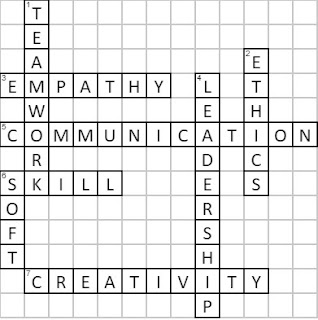
Today’s employers are also looking for so-called “soft skills” in hiring future employees. Soft skills include being able to communicate clearly and work as part of a team, ability to think critically and solve problems, managing your time and resources wisely, and being flexible, dependable, and accountable.

While you can learn about many soft skills through coursework or by watching YouTube, it’s very helpful to practice them in your daily life. Soft skills are not only important in your job, but they will make your professional and personal interactions with other people more successful as well.



Monday, October 25, 2021

October is Dyslexia Awareness Month


Image of a person's head as a jigsaw puzzle with two pieces displaced

Dyslexia is a neurological condition in which the brain’s “wiring” makes reading difficult. Brain anatomy studies and functional brain scans show that the brains of people with dyslexia are structurally, developmentally and functionally different from the brains of people without dyslexia. However, dyslexia is not brain damage nor a disease.

Dyslexia is not related to intelligence; highly intelligent people can have dyslexia. People with dyslexia may not read accurately or fluently, because they have trouble identifying the individual sounds that make up a word, or they can’t learn to relate a sound to a visual symbol like a letter. They may have difficulty decoding written or printed language, and may be poor spellers and have illegible handwriting. Having dyslexia may affect reading comprehension; persons who read less also tend to have smaller vocabularies and less general knowledge than more capable readers.

Children with dyslexia often face difficulty receiving an appropriate education. If their teachers do not understand their struggles, students with dyslexia may be tagged as lazy, stupid, or underachieving. However, many coping strategies are available. Dyslexia is now considered a specific learning disability, and can be covered by accessibility laws related to educational opportunities. About 14% of students have enough problem with dyslexia to qualify for special education services. With proper education and support, about 96% of students with dyslexia can become good readers.

For more information on adult dyslexia, please visit these sites:


Sunday, October 24, 2021

Easy Study Tool: Flashcards

A stack of 3 by 5 index cards used for memorization
Index cards for memorization

This old-fashioned tool used to be handwritten on the front and back of 3 by 5 index cards, but no longer. Now there are excellent e-versions which can include not only definitions but also pictures, sounds, and fill-in-the-blank questions. These modern flash cards are available as apps for iOS and Android devices. You can study anywhere! 

This tool is best for memorization and recall. Learning vocabulary in a new language, or multiplication and division tables, or chemical formula names, or famous painting or musical selection identification, or physics or mathematics formulas, or anatomical names, or… pretty much anything you need to commit to memory.

Several companies offer pre-made flashcards on a wide variety of topics, or you can create your own sets and then trade them. Some offer free services, others charge a fee. Many have created games to make studying more fun. Most keep stats so you can track your progress. The best flashcard sets optimize your memorization by repeating incorrect guesses later in your study session, and waiting to repeat correct responses for some set amount of study later on.

Here are some examples of companies offering flash card sets:

Give flash cards a try, no matter what you are studying.


Monday, October 18, 2021

What Can I Ask JAN About?

JAN can be a disabled employee’s best friend.  JAN is the Job Accommodation Network, a US organization that provides free, confidential information about job accommodations and disability employment issues to employees and employers worldwide. Within the US, JAN supports job accommodations under Title 1 of the Americans with Disabilities Act (ADA), as well as supporting entrepreneurial self-employment for persons with disabilities. JAN is federally funded by the U.S. Department of Labor, Office of Disability Employment Policy (ODEP).

According to the ADA, a reasonable workplace accommodation is a modification or adjustment to either the job requirement or the workplace environment that is made so that a qualified employee who has a disability can perform the essential functions of a job. It also applies to job applicants, meaning accommodations can be made so an applicant with a disability can participate in the job application process. JAN specialists can brainstorm with employers, employees or job applicants to identify potential accommodations.

While half of all accommodations cost nothing, JAN can help employers and employees figure out not only what accommodations might work, but also how to afford them. JAN maintains a list of public and private funding sources. JAN also has information on tax incentives for employers related to increasing accessibility for employees with disabilities.

You can search the JAN website for information on accommodations by disability, functional limitation,  work/task functions that need to be modified, types of accommodation, or other topics. You can also find links to many publications and other helpful resources.